Monitoring spotted eagle ray populations in the Turks and Caicos Islands using photo-identification
This study was established in April 2009
with the aim of gathering baseline data on the spotted eagle ray
populations around South Caicos. There are lots of questions still to
be answered about the behaviours and life histories of this species.
They are also an important resource in terms of dive tourism.
Photographs are collected from students
and staff at the School for Field Studies during waterfront activities
and added to a database of identified individuals. Locations, sex, time, group size and behaviours are recorded with the aim of investigating the demographics of the populations here and the associations that form between individuals.
Below is a map of South Caicos illustrating locations where individuals have been first sighted and the distances away that some have been seen on repeat sightings. Around 86 % of repeat sightings are from the same locations. For a description of each individual that has been documented so far in South Caicos click here.
Monitoring has recently been extended to Providenciales and Saba, Netherland Antilles in collaboration with dive centres SeaSaba, SabaDeepDivers and SabaDivers on the island.
CLICK HERE to read about the monitoring program which has recently been established around Providenciales.
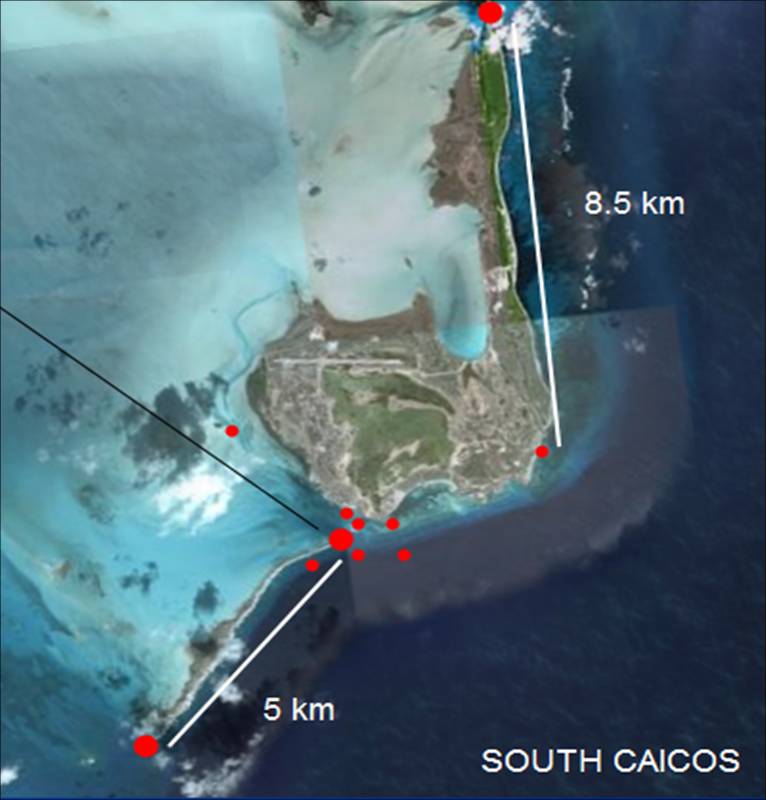
Photo-identification
The use of photo-identification techniques is less costly and invasive than other forms of tagging but can also be time consuming. Another aim of this project was to investigate the suitability of spot pattern matching software that is currently applied to whale shark, ragged tooth shark and manta ray research. The software (Interactive Individual Identification is free to download and modify (
