Online resources -
- Florida Museum of Natural History: http://www.flmnh.ufl.edu/fish/Gallery/Descript/SERay/SERay.html. Excellent summary about biology and ecology of species.
- IUCN (International Union for the Conservation of Nature). Redlist of threatened species: http://www.iucnredlist.org/details/39415/0. Biological description and explanation on conservation status.
- Fishbase: http://www.fishbase.org. Search for: Aetobatus narnari. Good site for scientific references on biology and fishing.
- Zipcode Zoo: http://zipcodezoo.com/Animals/A/Aetobatus_narinari
Current research from around the world -
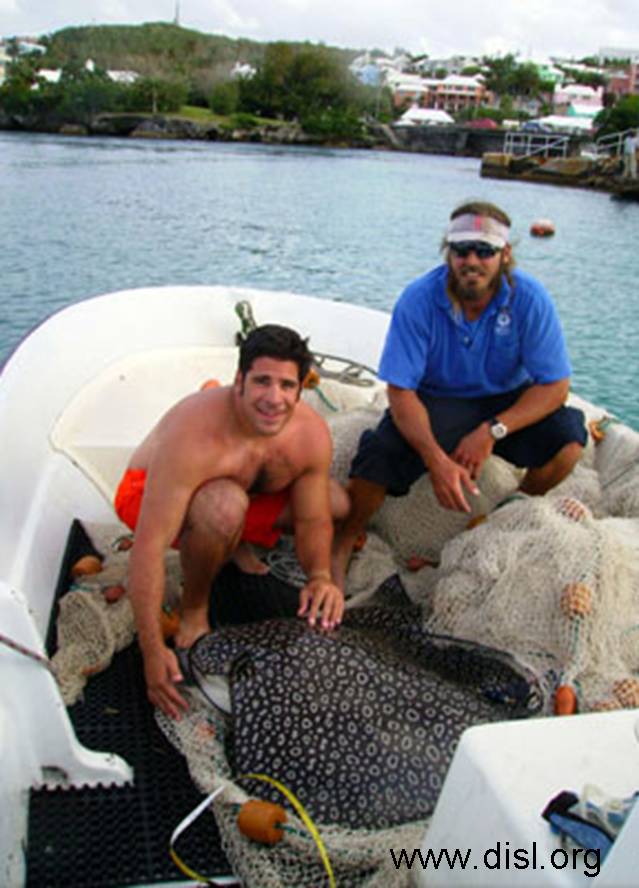
Contact information: Matthew J. Ajemian, PhD Student
Department of Marine Sciences,
University of South Alabama and Dauphin Island Sea Lab
101 Bienville Boulevard
Dauphin Island, AL 36528 (251) 861-2178
majemian@disl.org
http://fisherieslab.disl.org
Scientific publications -
- Chhapgar, B.F. (1964). A Monster of the Spotted Duck-Billed Ray, Aetobatus narinari. Copeia, 3: 587 - 589. (An unusual observation of an aquarium specimen exhibiting abnormal development during growth).
- Corcoran, M.J. & Gruber, S.H. (1999). The use of photo - identification to study social organization of the spotted eagle ray, Aetobatus narinari (Euphrasen 1790), at Bimini, Bahamas: a preliminary report. Bahamas Journal of Science, 7: 21-27. (Report of first ever study of spotted eagle rays using photoidentification techniques).
- Gudger, E.W. (1914). History of the Spotted Eagle Ray, Aetobatis narinari, with a Study of its external structures. In: Papers from the marine biological laboratory at Tortugas. Carnegie Institution of Washington. 183: 241 - 323. (A detailed observation and account of collected specimens including interesting old scientific drawings).
- Richards, P., Henning, M., Witzell, W. & Shivji, S. (2009). Species Delineation and Evolutionary History of the Globally Distributed Spotted Eagle Ray (Aetobatus narinari). Journal of Heredity, 100: 273 - 283. (Genetic analysis reporting distinction between populations in Western/Central Pacific and those in Eastern Pacific and Central Atlantic).
- Silliman, W. R. & Gruber, S.H. (1999). Behavioral biology of the spotted eagle ray, Aetobatus narinari (Euphrasen, 1790), in Bimini, Bahamas; an interim report. Bahamas Journal of Science, 7: 13-20. (A research report of tidal mediated movement patterns and behaviours using tagging techniques: the first of its kind).
- Tricas, T. (1980) Courtship and mating-related behaviours in Myliobatid rays. Copeia, 3: 553 - 556. (A detailed observation of a mating behaviour event in the Marshall Islands).
- Uchida, S., Toda, M. & Kamei, Y. (1990). Reproduction of elasmobranchs in captivity. In: Elasmobranchs as living resources: Advances in biology, ecology, systematics and status of fisheries, NOAA Technical Report. 90: 211-237. (Description of mating and birthing in an aquarium environment, with images).
- Yokota, L. & Lessa, R.P. (2006). A nursery area for sharks and rays in Northeastern Brazil. Environmental Biology of Fishes, 75: 349 - 360. (Records of juvenile white spotted eagle rays found in estuary areas).
- http://www.nhpa.co.uk
- http://seapics.com
- http://www.naturepl.com
- http://www.imagequestmarine.com
- http://www.arkive.org - images and videos free to download for educational purposes
